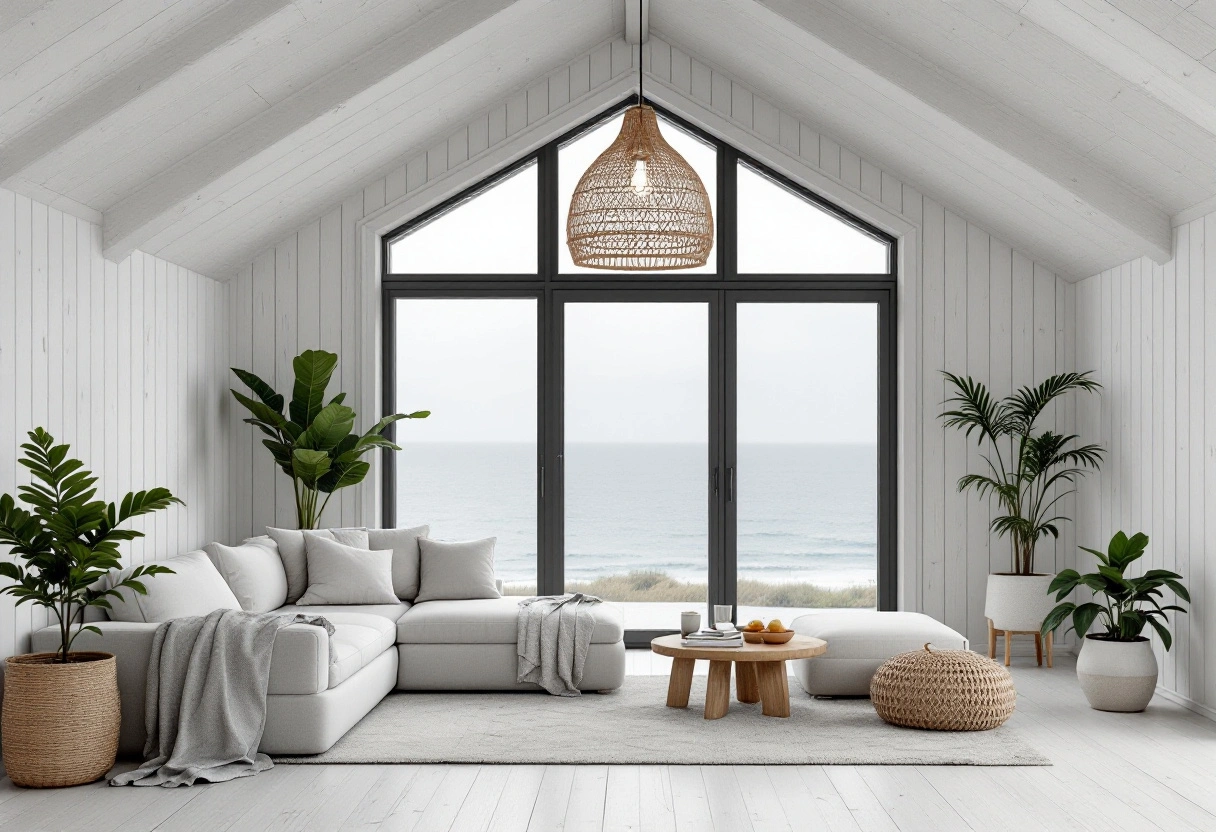
The sea is an overwhelming neighbour. Designers who forget this — who fill coastal rooms with pattern, with colour, with things competing for attention — produce interiors that exhaust rather than restore. The view is not a backdrop. It is the dominant feature of every room that faces it, and the interior’s job is to support that fact, not contest it.
The first principle, then, is compression. Coastal rooms benefit from a palette held tightly to three or four materials — stone, linen, oak, plaster — used consistently throughout. This compression creates visual calm that allows the eye to rest when it turns away from the window, and to return to it without the fatigue of having navigated too many competing surfaces. Variety in a coastal interior should come from texture and light, not from colour or pattern.
The second principle is durability as an aesthetic choice. Salt air is hard on materials that are not made for it. Fabrics should be either tightly woven naturals that age honestly or performance fabrics specified to a standard that allows them to withstand the conditions without the self-consciousness of obvious functionality. The same logic applies to flooring: stone or hardwood with appropriate sealing, rather than materials that require a degree of care incompatible with how coastal houses are actually used. A house at the sea is a working house. It should not make its owners nervous.
The third principle is threshold. The boundary between inside and outside is the most significant design decision in a coastal property. How a room opens to a terrace, how the flooring material relates to what lies beyond the door, whether the sill height of a window is low enough to allow the sea to be seen from a seated position — these decisions determine whether a room earns its location or merely occupies it. We spend more time on thresholds in coastal projects than on almost anything else. They are where the interior either succeeds or fails to justify itself.